Best Time to See Dolphins in Lanzarote
Dolphins are resident off Lanzarote year-round. Month-by-month guide to sea conditions, the whale season, best time of day, and when trips get cancelled.
The short answer is that there is no closed season. Bottlenose dolphins, Atlantic spotted dolphins and short-finned pilot whales are resident off Lanzarote’s south coast, not migratory visitors, and boats find them in January as well as July. What changes through the year is not really whether the animals are there — it is whether the sea lets you go looking comfortably, and whether your sailing gets moved.
Check Availability
Why Lanzarote has dolphins all year
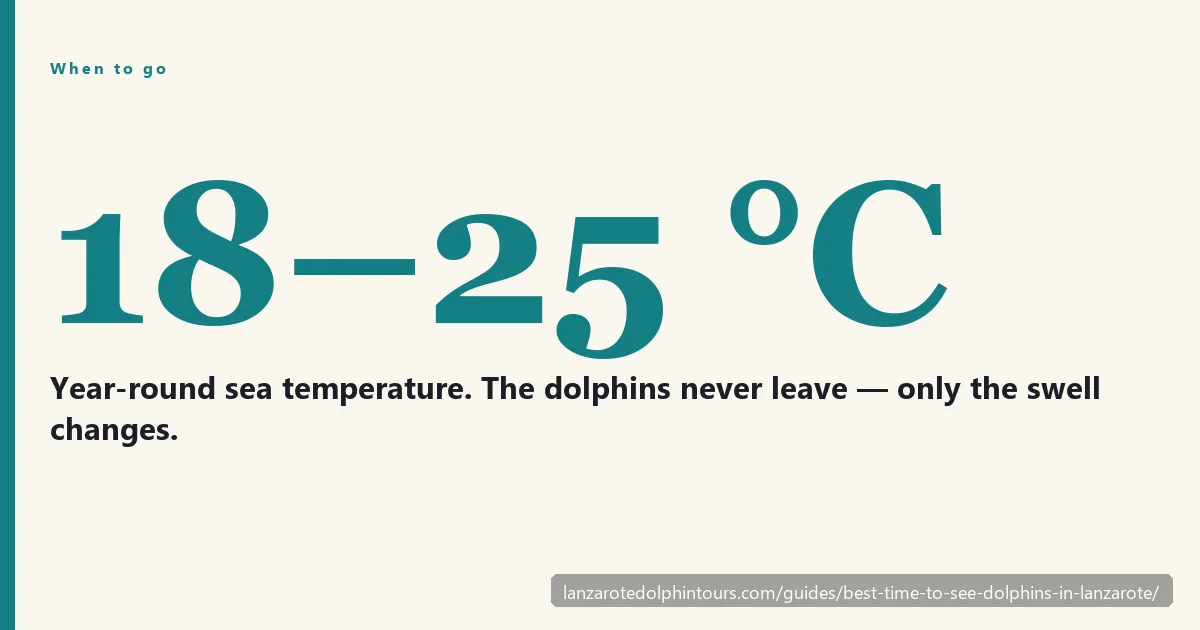
The reason is geography. The Canary Islands sit over very deep water very close to shore, the sea holds a stable 18–25 °C through the year, and the fish that cetaceans feed on stay with it. That combination is why at least thirty cetacean species have been recorded across the archipelago, and why the three regulars off Lanzarote do not need to go anywhere seasonally.
So unlike, say, Iceland or New England, you are not timing a migration. Crews and local guides report finding dolphins on roughly 60–65% of trips across the whole year — the same broad odds in February as in August. Treat that as the shape of the thing rather than a precise figure; it comes from operators describing their own trips, not an independent survey. Our guide to your chances of seeing dolphins covers what moves those odds.
What that means practically: if you are visiting Lanzarote in winter and someone tells you it is “the wrong time for dolphins”, they are wrong. It may be the wrong time for a comfortable boat ride, which is a different problem with a different solution.
Month by month: what actually changes
| Period | Sea conditions | Trips affected? | Notes |
|---|---|---|---|
| December – February | Roughest. Atlantic swell peaks | Cancellations most likely | Dolphins still resident. Book with free cancellation |
| March – April | Settling | Occasional | Whale-watching season opens; sunsets around 16:00–19:00 |
| May – June | Calm, warm, uncrowded | Rare | The sweet spot: good sea, pre-peak prices |
| July – August | Calmest and hottest | Rare | Best conditions, most crowded, book ahead |
| September – October | Still calm, warm sea | Rare | Second sweet spot: summer sea, fewer people |
| November | Swell returning | Increasing | Trips run; forecast-watching starts |
The window most consistently cited for the best conditions is May to October, and the broader whale-watching season is usually given as roughly March to October. Both are about sea state and comfort, not about the animals arriving or leaving.
If you have flexibility, May–June and September–October are the best value: the water is warm, the swell is low, the boats are not full, and the sunset slots are still available a day or two out. July and August have marginally better conditions and considerably worse availability.
Winter: what to expect if you are visiting anyway
Lanzarote’s winter is mild — this is not a season that shuts down — but the Atlantic gets serious, and that is what moves departures. Two consequences worth planning around.
Cancellations are an operator decision, not yours. When a sailing is called off for weather, operators typically offer an alternative date or a full refund. That is useful, but it does not help if you are leaving the island the next morning. The fix is to book your dolphin trip early in your stay, not on the last day, so a weather cancellation has somewhere to go.
Free cancellation is worth more in winter. Most trips on this site can be cancelled free up to 24 hours before departure. Between November and March that is the protection that actually matters, because you can watch a forecast and move yourself before the operator has to.
Boat choice also shifts in winter. A catamaran’s twin hulls handle swell far better than a rigid inflatable or a fast boat, so the sunset catamaran is the more comfortable winter pick even though all three run. If you are set on the RIB marine safari, aim for the calmer half of the year.
Best time of day
More decisive than the month, and less often discussed.
Late afternoon and sunset sailings dominate the Lanzarote market for a reason: the light is better, the wind typically drops, and the return leg gives you a sunset over the island’s volcanic ridgeline whether or not you found dolphins. The 2.5-Hour Sunset and Dolphins Cruise is built entirely around this — it leaves around 18:00 in the summer season (April–October) and around 16:00 in winter (November–March), tracking the actual sunset. Read our full breakdown →
Morning sailings have their own case. The sea is usually flattest early, which makes spotting a dorsal fin at distance easier and helps if you are prone to seasickness. The RIB operator runs a 2.5-hour morning tour with a swim stop at Papagayo for exactly this reason, and the Lobos Island half-day trip starts with a morning pickup.
There is no evidence that dolphins here are meaningfully more active at one time of day than another — they are resident animals feeding in deep water close to shore, not following a tourist schedule. Pick your slot on sea state and what else you want out of the trip.
Can you see whales in Lanzarote, and when?
Yes, with a definition. The whale you are most likely to see is the short-finned pilot whale — a large, blunt-headed member of the dolphin family that travels in family groups and tends to log quietly at the surface rather than charge the boat. Pilot whales are among the three species seen most regularly off Lanzarote, and they are present year-round like the dolphins.
The larger baleen and sperm whales people usually mean by “whale watching” are a different proposition: they do occur in Canarian waters, but they are rare, generally well offshore, and nothing to book a trip on. The whale-watching season quoted for the island — roughly March to October — reflects sea conditions and sighting opportunity, not an arrival.
If seeing a pilot whale specifically matters to you, the four-hour eco-catamaran works a wider search area than the two-hour coastal cruises and carries a hydrophone, so you can hear them even at distance. Read our full breakdown →
What to bring, whatever month you go
The single most common piece of advice from Lanzarote operators has nothing to do with season: bring warmer clothing than the land temperature suggests. The thermal sensation at sea is noticeably colder even in high summer, and a fast boat adds wind chill on top of it. One operator states this explicitly in its own listing.
Beyond that: sunscreen and a hat regardless of month, sunglasses (glare off the water is constant), and binoculars or a camera with a zoom. That last one matters more here than at most wildlife destinations, because Canary Islands law keeps every licensed boat 60 metres back from the animals. Sixty metres is further than it sounds.
Frequently Asked Questions
What is the best month to see dolphins in Lanzarote?
There is no single best month for the animals — bottlenose dolphins, Atlantic spotted dolphins and pilot whales are resident year-round. For sea conditions and comfort, May to October is the window most consistently recommended, with May–June and September–October offering the best combination of calm water, warm sea and available boat space.
Can you see dolphins in Lanzarote in winter?
Yes. The dolphins do not leave — the water stays 18–25 °C and they stay with it. What changes is the Atlantic swell, which makes departures more likely to be moved or cancelled between roughly December and February. Book early in your stay rather than on your last day, choose a catamaran over a speedboat, and take the free cancellation.
What time of day is best for dolphin watching in Lanzarote?
Late afternoon and sunset sailings are the most popular and give you the best light plus a guaranteed sunset even on a blank trip. Morning sailings usually have flatter water, which helps if you are prone to seasickness or want the easiest spotting conditions. There is no strong evidence the animals themselves are more active at either time.
When is whale watching season in Lanzarote?
Usually given as roughly March to October, though this reflects sea conditions rather than any migration. The whale most commonly seen is the short-finned pilot whale, which is resident year-round. Larger baleen and sperm whales are rare and generally far offshore.
Is November a good time for whale watching in Lanzarote?
It works, with caveats. November sits at the edge of the calm season: the swell is returning and cancellations become more likely, but the animals are present and the boats are running with far less competition for space than in August. Watch the forecast, book something with free cancellation, and prefer a catamaran to an inflatable.
Ready to book?
Whatever month you are visiting, compare every Lanzarote dolphin-watching boat or check live dates on the homepage booking calendar. Most trips cancel free up to 24 hours before departure — worth having in any season, and essential between November and March.
Go Looking for Lanzarote's Wild Dolphins
Bottlenose and Atlantic spotted dolphins are out there most of the year — and the boats that find them leave from Puerto del Carmen every afternoon. Free cancellation up to 24 hours before you sail.
Check Availability & Book