Catamaran vs Speedboat for Dolphin Watching in Lanzarote
Which boat to pick for dolphin watching in Lanzarote — sailing catamaran, electric eco-catamaran or RIB speedboat. Stability, group size, price and sea sickness compared.
Because Canary Islands law caps how close any boat may get to a pod, the hull under you ends up mattering more than it would anywhere else. Every licensed operator off Lanzarote stops at the same sixty-metre line — so what you are really choosing between is stability, group size, how much water gets covered, how much noise reaches the animals, and whether there is a mojito involved. Three boat types run these trips, and they suit genuinely different people.
Check Availability
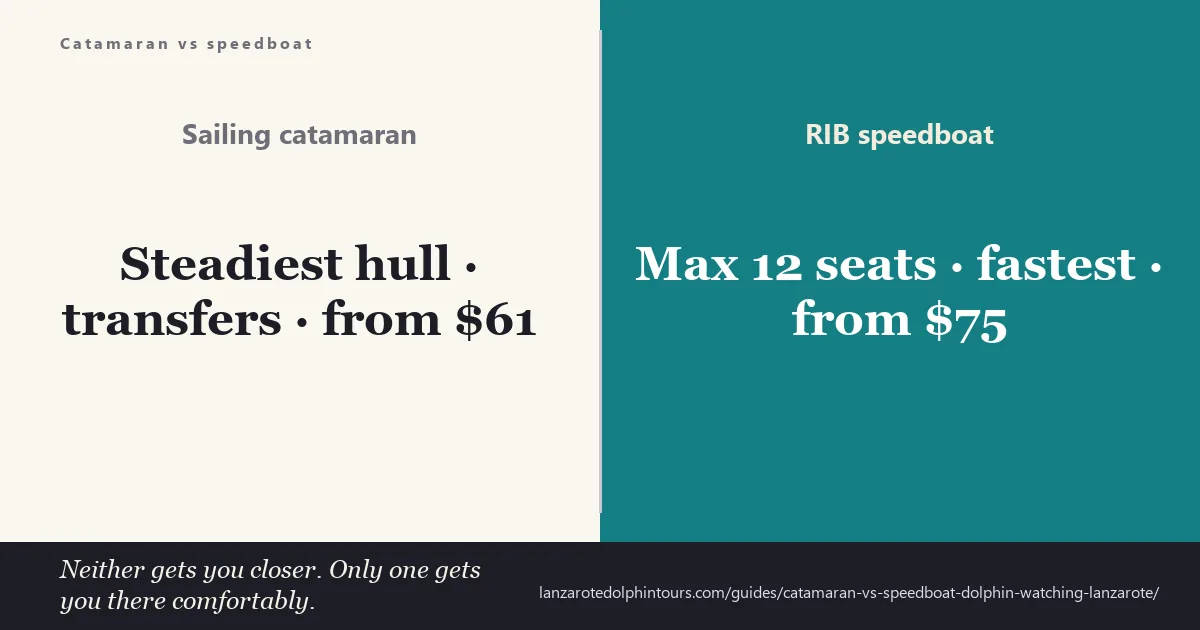
The three hulls at a glance
| Sailing catamaran | Electric catamaran | RIB speedboat | |
|---|---|---|---|
| Stability | Best — twin hulls | Best — twin hulls | Lowest; bouncy by design |
| Group size | Large | Medium | Max 12 |
| Noise to animals | Diesel | Silent, emission-free | Diesel, fast |
| Water covered | Coastal loop | Wide search area | Most, fastest |
| Trip length | 2–4 h | 4 h | 2–2.5 h |
| Transfers | ✓ Usually included | ✗ | ✗ |
| Drinks/food | Mojito, snacks or full lunch | Snacks, no alcohol | Water only |
| Price from | $61 | $110 | $75 |
| Sea sickness | Least likely | Least likely | Most likely |
The pattern is fairly clean. Catamarans buy you comfort, capacity and catering; the RIB buys you reach and intimacy; the electric catamaran buys you quiet and time. Nothing buys you proximity, because proximity is legislated.
Stability: the deciding factor for most people
A catamaran sits on two hulls, which is why it barely rolls compared with a monohull or an inflatable. In the Atlantic off Lanzarote’s south coast — where the water is rarely glassy and the swell picks up sharply from November onwards — that difference is not subtle.
It shows up in the operators’ own listings. The Papagayo Beaches catamaran day trip names motion sickness explicitly as a reason the trip may not suit you, and that is on the steadiest hull type running four hours. The RIB marine safari goes further and excludes children under 2 and pregnant travellers outright.
If you are unsure, take a catamaran. Sit low and central, keep your eyes on the horizon, and take any medication before boarding rather than once you feel it. The two-hour sunset catamaran cruise is the gentlest introduction: stable hull, short duration, sheltered coastal route. Read our full breakdown →
Group size and sightlines
Here the RIB wins convincingly. Capped at twelve passengers, it means nobody is watching over three rows of heads when a pod comes up on the port side. A large catamaran carrying dozens can leave you on the wrong side of the boat at the moment that matters.
The RIB’s other advantage is agility: it repositions fast when a sighting comes in, and reviewers of the Waverider trips repeatedly single out the skippers as determined about actually finding animals, mentioning sea turtles alongside dolphins. If you want the highest chance of a clear, close-as-legal look and you do not mind a rough ride, that is the trade.
What you give up is everything else. Only the boat, skipper, lifejacket and water are included — no lunch, no bar, no hotel pickup on the shared options — and the listing carries an extra charge of €5 per person on top of the booking price. Read our full breakdown →
Noise: the argument for the electric catamaran
This is the variable most travellers never consider, and the one with the best claim to affecting your actual odds.
Engine noise is the primary way a tourist boat changes cetacean behaviour. A pod that hears a diesel hull coming from a kilometre out has already decided what to do about it before the boat reaches the sixty-metre line. The Whale and Dolphin Watching Eco-Friendly Catamaran, operated by WeWhale out of Marina Puerto Calero, is the first fully electric, emission-free catamaran in the Canary Islands — it arrives silently, and can hold position beside a pod without pushing it.
It also carries an onboard hydrophone, the only one among these trips. Since the law keeps you sixty metres out regardless, being able to hear the animals clicking and whistling is arguably the single biggest upgrade available on this island. Four hours also gives it time to work a genuine search area rather than a fixed coastal loop.
At $110 it is the most expensive trip here, has no hotel transfers, and does not serve alcohol — snacks, soft drinks and fresh fruit only. It also holds the highest rating of the six at 4.6 out of 5. Read our full breakdown →
What “sailing catamaran” actually means here
Worth a clarification, because the word does some work in the marketing. The Líneas Romero catamarans are wide, stable, motor-assisted sailing vessels built for lounging: trampoline nets at the bow you can lie on above the water, shaded seating aft, and a bar. They are not racing yachts, and you will not be crewing.
That is exactly why they dominate the sunset market. The two-hour sunset cruise is really a comfortable evening on the water with a dolphin search folded in — welcome mojito, a second drink, a snack box, and the sun going down over the volcanic ridgeline on the return. Its 4.2 rating from more than 3,000 travellers is among the lowest of the six, and a fair share of those low reviews come from people who booked expecting a guaranteed sighting.
The four-hour Papagayo day trip is the same hull with a different purpose — open bar, paella lunch, kayaks, and roughly two hours anchored off the coves for swimming and snorkelling. Dolphins there are a bonus on a beach day, not the itinerary. Read our full breakdown →
And the fast boats that are not RIBs
One more category, easy to miss. The 2.5-Hour Sunset and Dolphins Cruise uses the Biosfera Jet — a modern fast boat rather than either a catamaran or an inflatable. It sits between the two: livelier than a catamaran, considerably more sheltered than a RIB, and it covers more coastline than a sailing hull manages in the same window.
It is also the cheapest trip on the island at $60, includes hotel pickup by air-conditioned coach, and serves sparkling wine or juice with local pastries on the return leg. Reviewers rate the wildlife and the organisation warmly and the refreshments less so. If you want maximum time at sea for minimum money and can handle a bouncier ride than a catamaran, this is the value pick. Read our full breakdown →
The Lobos Island half-day trip uses the same class of fast boat for its 1.5-hour crossing each way, with 2.5 hours ashore in between.
Frequently Asked Questions
Is a catamaran or a speedboat better for seeing dolphins in Lanzarote?
Neither has an advantage on the animals themselves — the sighting rate of roughly 60–65% is island-wide, and every licensed boat stops at the same 60-metre line. Choose on ride quality and group size: a catamaran for stability, catering and transfers; a RIB for a twelve-person group, fast repositioning and clear sightlines.
Which Lanzarote dolphin boat is best if I get seasick?
A catamaran, without much question. Twin hulls are far steadier in Atlantic swell than a monohull or an inflatable. The two-hour sunset catamaran cruise is the gentlest option available: stable, short, and on a relatively sheltered coastal route. Avoid the RIB, which is bouncy by design and excludes some passengers outright. Our guide to how to avoid seasickness on a dolphin tour covers seating, food and medicine.
Why is the electric catamaran more expensive?
It runs four hours rather than two, uses a purpose-built electric vessel, carries a hydrophone, and works a wider search area than the coastal cruises. It also holds the highest rating of the trips compared here at 4.6 out of 5. You are paying for time, quiet and a genuinely different kind of wildlife experience rather than for a shorter cruise with drinks.
Does a faster boat mean a better chance of seeing dolphins?
Not directly. A fast boat covers more water and can reposition quickly on a reported sighting, which helps at the margin — but it is also noisier on the approach, and noise is the main thing that changes cetacean behaviour. A silent electric hull that spends four hours in the search area is arguably the better bet, and a two-hour coastal cruise the weaker one.
Do any of these boats include hotel transfers?
The catamaran and fast-boat cruises generally do — the featured sunset cruise collects from seventeen points across the island, and both Lanzarote Sea Tours trips include coach pickup. The RIB safari and the electric eco-catamaran do not: you make your own way to the Old Cruise Port in Puerto del Carmen and to Dock F22 at Puerto Calero respectively.
Ready to book?
Compare all three hull types side by side on the full tour list, or check live dates for the featured sunset catamaran on the homepage booking calendar. Most trips cancel free up to 24 hours before departure.
Go Looking for Lanzarote's Wild Dolphins
Bottlenose and Atlantic spotted dolphins are out there most of the year — and the boats that find them leave from Puerto del Carmen every afternoon. Free cancellation up to 24 hours before you sail.
Check Availability & Book