What to Expect on a Lanzarote Dolphin Watching Trip
Where Lanzarote's dolphin boats leave from, which species you will see, how the 60-metre rule changes the trip, which tour type to book, what to bring and the odds of a sighting.
Most disappointment on a Lanzarote dolphin trip comes from a mismatch of expectations instead of a bad boat. People arrive picturing the marketing photograph — a bottlenose dolphin arcing three metres from the rail — and get a legally-mandated sixty metres, a scan of open water, and a sunset. That is a good afternoon if you know it is coming. This guide covers what the day looks like: the ports, the animals, the rules, the kit and the odds, then which kind of trip to book, how to photograph a pod and what to confirm before you pay.
Check Availability
Where the boats leave from
The dolphin fleet works Lanzarote’s south and southwest coast, where the seabed drops away fast and the animals feed close to shore. Three departure points matter.
Puerto del Carmen is the busiest, and the base for most sunset cruises. Two harbours are in play: the old town harbour, where Lanzarote Sea Tours board beside the roundabout at the entrance to the port car park, and the Old Cruise Port, where the RIB safaris leave from. The Papagayo catamaran boards at the last pier, at the far end of the harbour past the petrol station — read that twice, because “Puerto del Carmen harbour” covers a lot of quay.
Puerto Calero, a few kilometres west, is a quieter marina and home to the island’s all-electric eco-catamaran, berthed at Dock F22. There is parking, and it is a straightforward bus or taxi from Puerto del Carmen.
Playa Blanca / Marina Rubicón at the southern tip is where the Lobos Island and Fuerteventura crossings begin, and a pickup area for several operators. Most boats here sell Papagayo beach days, private charters and island crossings, so a dolphin-first trip usually means a transfer to Puerto del Carmen or Puerto Calero.
If you are staying in Costa Teguise or Arrecife, you are not excluded — you want a trip with transfers. The featured sunset cruise collects from seventeen points across Puerto del Carmen, Playa Blanca, Puerto Calero, Costa Teguise and Arrecife. Two scheduling quirks to note: Puerto Calero pickup runs Thursdays only, and there is no Playa Blanca pickup on Sundays, Mondays or Wednesdays. Read our full breakdown →
What you will actually see
Three species account for the large majority of sightings, and they behave completely differently from each other.
Bottlenose dolphins (Tursiops truncatus) are the classic: large, curious, and the most likely to come and ride the pressure wave off a moving bow. This is the animal in the marketing photograph, and it is genuinely common here.
Atlantic spotted dolphins (Stenella frontalis) are smaller and travel in bigger, more energetic groups. If you get the leaping, splashing display that people remember, it is usually this species.
Short-finned pilot whales (Globicephala macrorhynchus) are the surprise for most visitors. Despite the name they are large members of the dolphin family — dark, blunt-headed, travelling in tight family groups — and they behave nothing like the other two. Pilot whales tend to log quietly at the surface instead of charging around, so a good pilot whale sighting looks calm instead of acrobatic. Recognising that in the moment is the difference between “we saw whales” and “nothing much happened”.
Beyond the three: common dolphins, striped dolphins, rough-toothed dolphins, Risso’s dolphins and beaked whales all occur, and the wider Canary Islands have at least thirty recorded cetacean species. Sperm whales and larger baleen whales are rare and usually well offshore. Do not book on the rare list. Reviewers of the Lobos Island trip report pilot whales, Atlantic spotted dolphins, common dolphins and flying fish on good crossings — that is a realistic good day.
The sixty-metre rule, and what it does to the experience
This is the single biggest gap between expectation and reality, so here is the blunt version.
Cetacean watching in the Canary Islands is regulated under Decree 178/2000. A licensed boat must hold a minimum of 60 metres from the animals, must disengage its propellers when they come within 100 metres, may not stay indefinitely with a group, and must carry a qualified guide. Swimming and diving are prohibited within 500 metres. Boats licensed under the decree display the Barco Azul — “Blue Boat” — symbol on a yellow Canarian flag.
What that means on the water: the skipper approaches slowly, cuts power, and drifts. The pod then either comes to the boat or does not. When bottlenose dolphins choose to bow-ride you will get close encounters — because they came to you, which is legal — and when they do not, you are watching from sixty metres.
Two practical consequences. Bring binoculars or a zoom lens; this is the most useful thing on the whole page. And be suspicious of any operator whose photos show a boat right on top of a pod — that is not a better trip, it is a rule breach or a photograph taken elsewhere.
The shape of the afternoon
The formats vary but the rhythm is consistent.
Crews ask you to board 15–20 minutes before departure. Get there early enough to choose where you sit: the trampoline nets at a catamaran’s bow are the best seat on the boat and go first, and on a large vessel the side you pick changes what you see.
The briefing is where a good crew sets expectations honestly — sightings are not guaranteed, the operator says so in writing, and there are no refunds for a blank trip. Then comes the coastal leg, which is genuinely worth the ticket on its own: black lava cliffs dropping into deep blue water, the Ajaches massif to the south, and on the Papagayo run the golden coves at the island’s southern tip.
Crew and passengers scan together. Sightings are called; the boat repositions; engines cut. On the sunset sailings the return leg is the payoff regardless — a mojito or a beer, a snack box, and the light going gold behind the volcanoes. Start times on those trips shift through the year because they track the actual sunset, so read your voucher instead of assuming a fixed slot.
What to bring
Warmer clothes than you think. Operators here flag this specifically: the thermal sensation at sea is noticeably colder than on land even in high summer, and a fast boat generates its own wind chill on top. A windproof layer for the return leg after sunset is not optional.
Sun cover. Sunscreen, a hat and sunglasses. Glare off open water is relentless and there is often little shade.
Optics. Binoculars or a camera with real zoom, for the reason above.
Swimwear and a towel — but only if your trip actually has a swim stop. The Papagayo catamaran, the Lobos Island trip and the RIB’s morning tour do; the two-hour sunset cruises do not, and the featured cruise excludes a swimming stop explicitly. Snorkelling gear is generally not supplied, so bring your own mask if you want one.
Motion-sickness medication, taken before boarding instead of once you feel it. And note what is not allowed: several boats prohibit glass bottles, smoking, alcohol brought aboard, and party groups.
The honest odds
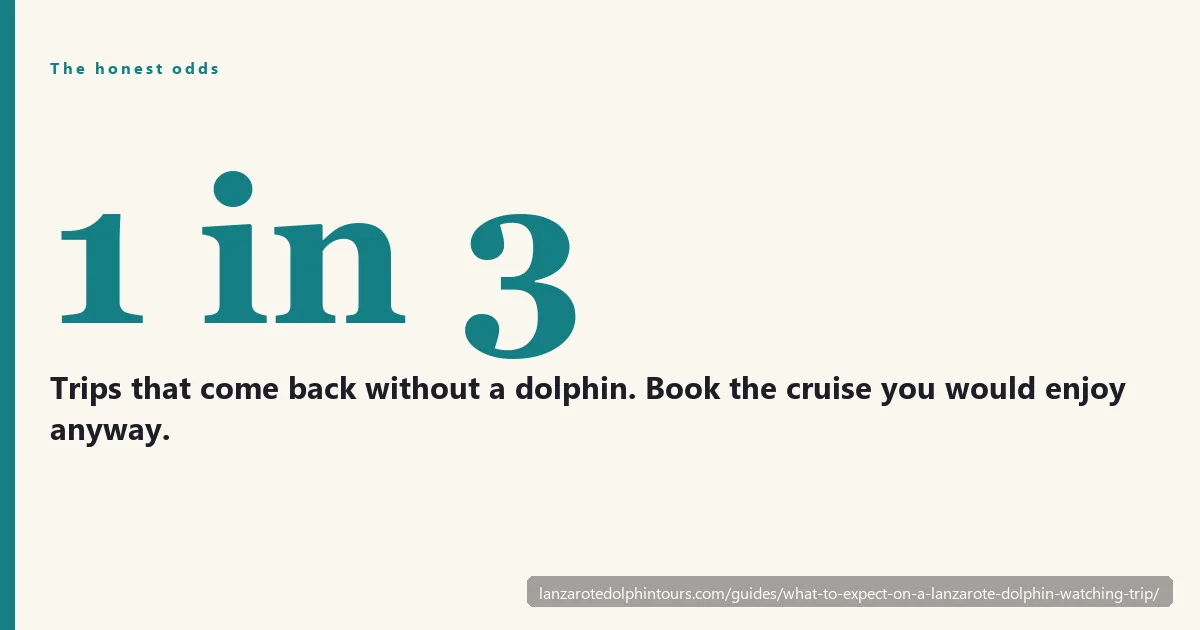
Crews and local guides consistently report finding dolphins on roughly 60–65% of trips across the year. By wildlife-watching standards that is strong — better than most whale-watching destinations manage — but treat it as a rough guide, not a precise figure, since it comes from operators describing their own trips, not from an independent survey.
The arithmetic that matters: about one trip in three comes back without a dolphin. Every listing says sightings depend on weather, sea conditions and animal behaviour, and that there are no refunds or reschedules for a trip that finds nothing. Our guide to your chances of seeing dolphins on a Lanzarote tour explains what improves the odds.
Which points to the only reliable strategy. Book the boat trip you would enjoy anyway — the sunset, the drinks, the coastline, the island landing — and treat the dolphins as the upside. Read the enthusiastic reviews of these trips and you will notice that almost all of them are written by people who did exactly that.
Dedicated dolphin trip or leisure cruise?
If dolphins are your main reason for going, compare what the boat does once it leaves harbour, not its size or length. A dedicated wildlife trip spends its time offshore searching. A leisure catamaran spends much of the day sailing to a beach, serving lunch or anchored for a swim, so any dolphins you meet on it are a bonus. Look in the itinerary for words such as cetacean watching, dolphin search or marine wildlife. A short trip that searches for almost all of its time can give you more time with wildlife than a much longer cruise with lunch and a long anchorage.
The trips on this site split four ways:
- A focused search from Puerto del Carmen: the WaveRider speedboat dolphin-watching trip ($75, rated 4.4 out of 5 from 136 reviews) covers water quickly on a RIB. Expect spray and a firmer ride.
- A small-group specialist trip from Puerto Calero: the electric whale and dolphin watching catamaran ($110, rated 4.6 out of 5 from 138 reviews) is quieter and slower, with far fewer passengers than the big boats.
- Dolphins first, then the sunset: the 2.5-hour sunset and dolphins boat ($60, rated 4.2 out of 5 from more than 1,700 reviews) searches before settling in for the evening light.
- A beach day with a dolphin chance: the Papagayo catamaran ($76, rated 4.4 out of 5 from more than 1,100 reviews) is for swimming and the southern coves; dolphins are possible but not the plan.
Pick the RIB if you want the most searching for the price and do not mind a bumpy ride, and the electric catamaran if a calm, small group matters more than the $35 difference. Our tour-by-tour comparison sets all of them side by side.
Dolphins are here all year, so the sea on the day matters more than the month; the best time to see dolphins guide covers the seasons. Book the trip in the first half of your holiday. Atlantic wind and swell can cancel or reroute a single departure, and an early date leaves you room to rebook. A trip on your last afternoon leaves none.
What makes a better sighting
A high advertised sighting rate tells you less than these do:
- how much of the trip the crew spends searching;
- how well the crew knows local waters;
- sea state and visibility;
- whether the boat can move quickly between search areas;
- how the skipper behaves once animals are found.
Calm water makes dorsal fins, blows and surface activity much easier to spot, and it helps your photographs and your stomach. Cloud is no problem: dolphins surface the same with or without sunshine.
A good skipper slows down, keeps movements predictable and never surrounds, splits or blocks a group. If the dolphins approach, the encounter can still be very close; the point is that the animals set the distance. Treat any promise of touching, feeding or swimming with wild dolphins as a red flag. The Canarian rules above ban swimming within 500 metres, and our guide on whether you can swim with dolphins in Lanzarote explains the alternatives.
Photographing dolphins from the boat
Dolphins rarely stay up long enough for you to change settings. Keep the camera on and ready, use burst mode, and leave the zoom wide enough to keep a fast animal in the frame. Watch which way the pod is travelling before you raise the camera, because dolphins often surface again farther along the same line.
On a RIB, use a wrist strap or a lanyard and expect plenty of movement. On a catamaran, use the extra deck space to change angle. On either boat, stop scrolling through your shots during the encounter: you miss the next surfacing, and looking down makes seasickness worse.
Before you pay: what to confirm
- The actual departure harbour.
- How long you spend on the boat, separate from transfers.
- Whether the wildlife search is the main purpose or a possible bonus.
- Boat type and passenger numbers.
- Whether hotel transfers are included.
- Cancellation and bad-weather terms.
- What happens if you see no dolphins.
- Age and mobility limits.
- Whether food, drinks or a swim stop are included.
- That the boat flies the Barco Azul flag of a licensed cetacean-watching vessel.
Frequently Asked Questions
Are there really dolphins in Lanzarote?
Yes, and they are resident all year, not seasonal visitors. Bottlenose dolphins, Atlantic spotted dolphins and short-finned pilot whales live in the deep water off the south coast year-round, supported by a stable 18–25 °C sea and the fish that come with it. The wider Canary Islands have at least thirty recorded cetacean species.
Where is the best place to see dolphins in Lanzarote?
From a boat off the south or southwest coast — Puerto del Carmen, Puerto Calero and Playa Blanca are the departure points, and the water deepens quickly just offshore, which is where the animals feed. Watching from land is technically possible but the odds are very low; these are deep-water animals, not surf-line ones.
Can you see whales in Lanzarote?
Yes, most often the short-finned pilot whale — a large, blunt-headed member of the dolphin family that is among the three species seen most regularly here and is present year-round. Larger baleen and sperm whales occur in Canarian waters but are rare and generally far offshore, so they are not a reason to book.
Can I go dolphin watching from Costa Teguise or Playa Blanca?
Yes. No dolphin boats depart from Costa Teguise itself, but several operators run hotel transfers there — the featured sunset cruise collects from seventeen points including Costa Teguise and Arrecife. Playa Blanca has its own departures from Marina Rubicón, mainly the Lobos Island and Fuerteventura crossings, and is also a pickup area.
How close do the dolphins get to the boat?
Legally the boat may not approach closer than 60 metres, and must cut its propellers within 100 metres. But the animals may choose to come closer, and bottlenose dolphins frequently do — bow-riding is common and entirely legal, because they made the approach. Bring binoculars for the times they stay out.
What happens if we do not see any dolphins?
The trip runs as scheduled and there is no refund. Every listing states that sightings are not guaranteed and depend on conditions and animal behaviour. Weather cancellations are different: if the operator cancels a sailing for sea conditions, you are normally offered an alternative date or a full refund.
Can you swim with wild dolphins in Lanzarote?
No. Swimming and diving are banned within 500 metres of cetaceans in Canarian waters. Where a trip includes a swim stop, it happens away from any animals and is separate from the wildlife watching.
Is Puerto del Carmen the best base for dolphin watching?
It is the most convenient base for dedicated dolphin trips, with the most departures and the widest choice of boats. Puerto Calero suits you better if you want a small-group, quieter specialist trip.
Ready to book?
Compare every Lanzarote dolphin-watching boat with live prices and ratings, or check dates for the featured sunset cruise on the homepage booking calendar. Not sure which suits you? Start with the picking guide.
Go Looking for Lanzarote's Wild Dolphins
Bottlenose and Atlantic spotted dolphins are out there most of the year — and the boats that find them leave from Puerto del Carmen every afternoon. Free cancellation up to 24 hours before you sail.
Check Availability & Book